


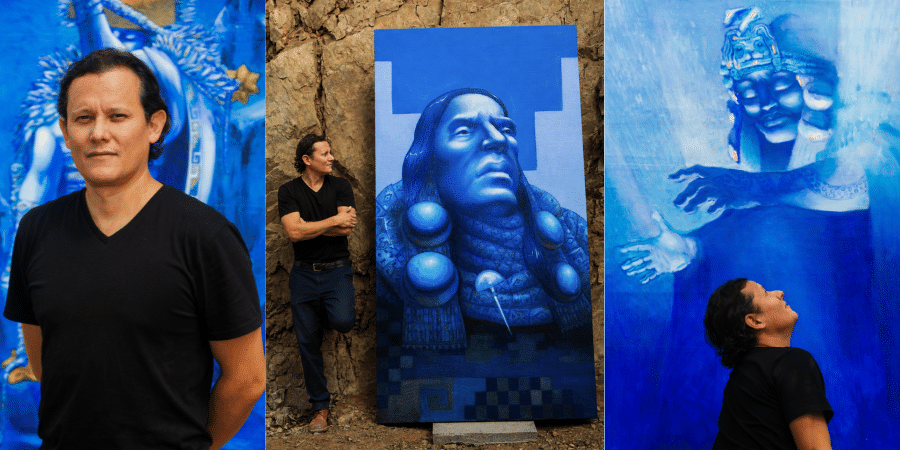
Some stories are known to us because they were written down. Others remain alive because art finds new ways to tell them.
Whispers of the Empire, an exhibition by Peruvian artist Ángel Loaiza, drew inspiration from the world of Ollantay to offer an interpretation that moves away from traditional historical narrative and toward the intimate, the symbolic, and the human.
The exhibition ran from July 10 to August 9, 2026, at the Limaq Art Gallery of the Metropolitan Museum of Lima, with the support of Atoq Hoteles and the Municipality of Lima. Through paintings and drawings, Loaiza brought his characters into a space where history, memory, myth, and imagination coexist.
For Atoq Hoteles, supporting this exhibition was also a way to continue celebrating what lies at the heart of its own identity: Peruvian art, its creators, and the diverse forms of expression that allow us to connect with our culture through new perspectives.
Ollantay is one of the foundational works of the Andean dramatic tradition. However, Whispers of the Empire does not seek to reconstruct its events or portray its characters literally. Ángel Loaiza’s approach draws on research into elements associated with the Andean visual imagination—such as unkus (traditional tunics), facial tattoos, and headdresses found in museum pieces and archaeological collections—and combines them with elements born of his own imagination. From this starting point, he creates characters who seem to break free from time and inhabit a different dimension.
History thus becomes more than a story about characters and events. It becomes an opportunity to explore what lies beneath them: emotions, relationships, silences, and human experiences that can transcend generations. In this sense, the exhibition offers a poetic reinterpretation of the world of Ollantay—a way of returning to a familiar story to discover new dimensions within it.
One of the exhibition’s most recognizable features is the color blue. In Loaiza’s works, blue is more than an aesthetic choice; it becomes a language of its own. The figures take on an almost ethereal appearance, as though suspended between the earthly world and a more spiritual realm.
The exhibition’s own conceptual framework presents blue as a symbol of transformation and transcendence: a space where flesh becomes spirit and characters cease to belong solely to a historical dimension, becoming symbolic presences instead. The blue figures in Whispers of the Empire thus seem to speak of something that extends beyond their time. They are connected to an ancestral history, yet they also embody deeply human emotions and questions: memory, desire, fragility, and the need to express what words cannot always convey.
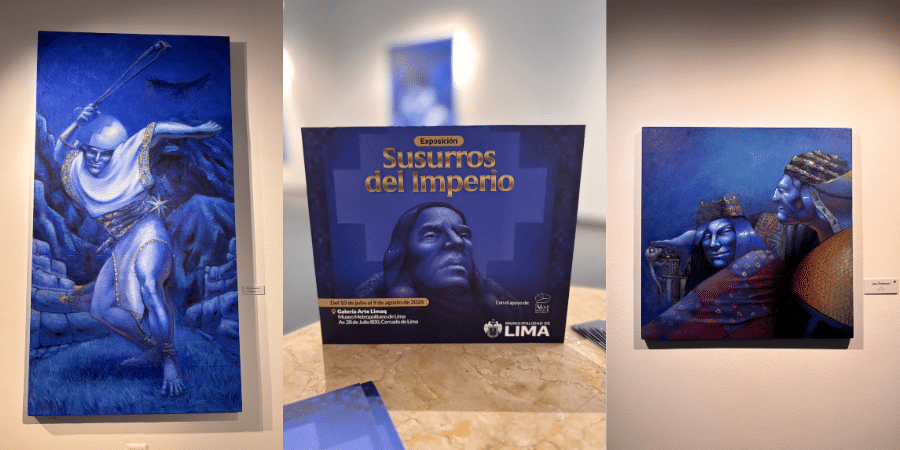
One particularly compelling aspect of the way Loaiza creates his characters is that what unfolds in a scene is often not conveyed through an obvious action, but through a gaze, a gesture, or a posture.
The exhibition explores nonverbal communication as an essential dimension of the human experience. Silences tell stories, too. Glances narrate. The tensions held in the body can express what words leave unsaid.
Works such as Complicity and The Chicheros transform everyday situations into something more profound, revealing how an apparently simple moment can take on a different meaning when viewed through the sensitivity of art.
Perhaps this is why the exhibition feels less like a reconstruction of the past and more like a dialogue with it. Looking at these works is not simply a matter of wondering who these characters were, but of asking which emotions we can still recognize in ourselves.
Whispers of the Empire places its characters in an in-between realm: between history and eternity, between memory and myth, between what we know and what we imagine.
Loaiza’s approach does not seek to revisit the past in order to reproduce it, but to engage with it through a contemporary sensibility. The world of Ollantay thus becomes a starting point for exploring something broader: the human condition and the experiences that remain relevant even centuries later.
History is made up of more than great events. It is also shaped by affection, silence, relationships, and shared experiences. And it is precisely here that art can open up new ways of seeing.
For Atoq, engaging with Peruvian art is also a way of bringing guests closer to the country they have come to discover. Behind Atoq Hoteles is a family that has consistently prioritized its connection with Peruvian art, handicrafts, local products, and the country’s creators.
This perspective is reflected in its spaces and in the way each hotel seeks to incorporate elements that connect guests with the places they visit. Art, therefore, is not simply a decorative feature. It is part of a broader intention: to share Peru through the people who create it, interpret it, and transform it. The collaboration with Whispers of the Empire reflects this same vision.
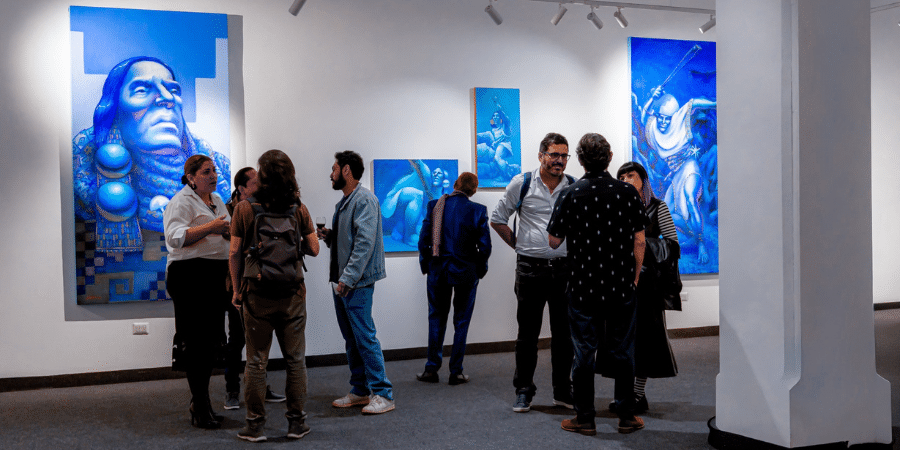
The relationship between Atoq and Ángel Loaiza can also be experienced within the hotels themselves. The artist’s works are displayed throughout Atoq’s spaces, alongside pieces by other Peruvian creators.
At Atoq San Blas in Cusco, some of these works are part of Paqarina, the hotel’s art gallery, which complements the guest experience. In this setting, encountering a work of art during a stay does not necessarily mean making a formal visit to an exhibition. It might happen while walking through the hotel, waiting, having a conversation, or simply taking in the surroundings.
This is precisely one of the experiences Atoq seeks to create: allowing encounters with art to become a natural part of the journey. In Cusco, this intention takes on an especially meaningful dimension. Atoq San Blas is located in a neighborhood traditionally associated with art, craftsmanship, and creative expression, and Paqarina allows that connection to continue within the hotel itself.
Atoq’s commitment to art is part of a broader vision of hospitality and of welcoming those who travel to Peru. Art is one way of telling the story of who we are. So are handicrafts, gastronomy, local products, the ingredients that make their way to the table, the stories we preserve, and the people who continue creating from them.
That is why both Atoq San Blas and Atoq Paracas Reserva seek to bring guests closer to artistic expressions and products connected to our country. Two very different destinations can reveal Peru from entirely different perspectives. Cusco does so through the Andes, its history, its traditions, and its extraordinary cultural richness. Paracas offers a perspective shaped by the sea, the desert, the coastal landscape, and the distinctive expressions of this part of the country.
What connects them is the intention to celebrate what is local and make travel an opportunity to discover it.
Perhaps this is one of art’s most compelling possibilities: allowing us to look again at what we thought we already knew. In Whispers of the Empire, Ángel Loaiza revisits a familiar story and takes it somewhere new, where the characters become more than figures in a historical narrative. They become memory, myth, humanity, and silence.
The exhibition has come to an end, but its message remains an invitation to view our history from different angles and recognize that a country’s cultural expressions can continue to find new ways of speaking to the present.
And it is precisely this encounter with Peru’s many forms of expression—its artists, artisans, stories, and creators—that Atoq seeks to share with those who stay at its hotels. Because traveling can also be a way of seeing things anew and looking a little deeper.
Atoq Hotels 2022 - All rights reserved
